

Auditoriums, Institutions & Offices: Designing Scalable AV and Networking from the Ground Up
In 2025, technology isn’t just part of your space—it defines how it functions. Whether you’re setting up a smart auditorium, a multi-building institution, or a dynamic office, your audio-visual (AV) and networking infrastructure must be built to scale.
Let’s break down how to approach scalable AV and networking with long-term success in mind.
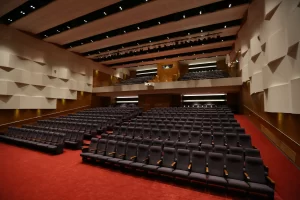
1. Start with the End in Mind: Understand Future Usage
Too often, AV and networking systems are installed based on current needs only. But institutions grow. Offices add teams. Auditoriums start hosting hybrid events.
Ask:
-
Will you need to support 4K or 8K streaming in the next 2–3 years?
-
How many simultaneous video conferences will run daily?
-
Are remote access, cloud backups, or smart automation required?
Designing for future capacity now saves massive rework later.
2. Centralized Architecture with Modular Flexibility
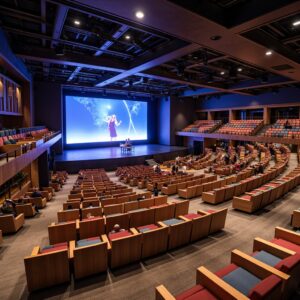
Scalable systems rely on modular design—the ability to add or swap components without overhauling the entire setup.
-
For AV: Use matrix switchers, centralized control processors (like Crestron or Extron), and IP-based distribution.
-
For Networking: Implement a structured cabling system, scalable switches, and VLANs for traffic control.
This approach enables:
Easy upgrades
Minimal disruption
Better performance management
3. Smart Cabling & Power Planning

The backbone of any scalable system is the physical layer—cables, conduits, and power. Plan with:
-
Extra conduits for future cable pulls
-
Cat6A or higher Ethernet cabling for 10Gbps support
-
Redundant power supplies and centralized UPS units
Don’t underestimate this step—bad cabling = bottlenecks.
4. Secure & Scalable Networking Design

A modern institution or workspace demands a network that’s:
-
Segmented (via VLANs) for departments and AV systems
-
Monitored in real-time for threats or slowdowns
-
Easily expandable with additional switches or Wi-Fi access points
Don’t forget firewall configurations, cloud management (e.g., UniFi, Cisco Meraki), and automated failover routing.
5. AV Integration for Multi-Use, Multi-Zone Spaces
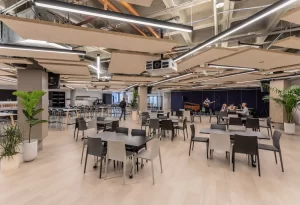
Auditoriums, classrooms, and boardrooms all need different AV behaviors. With scalable design:
-
Central control rooms can manage multiple zones
-
Wireless AV streaming (like AirMedia or Barco ClickShare) can be added later
-
Events can scale from small presentations to full broadcasts
Make sure AV and IT teams work together from the design stage—not just installation
6. Partner with the Right System Integrator

To build a scalable foundation, you need a partner who:
-
Understands both tech and architecture
-
Can provide end-to-end service (design → procurement → deployment → support)
-
Is certified (ISO, GEM, MSME) and experienced in AV + IT convergence
NetworkTen has helped institutions, offices, and auditoriums across India design future-ready spaces that evolve with time—not against it.
Final Thought
Scalability isn’t a luxury—it’s a requirement.
If you’re planning a new space or upgrading an existing one, ask yourself:
Will this infrastructure still serve us when we double in size?
If the answer is no, start from the ground up—and build it right.